Copyright
Below you can read about the various aspects of copyright that you may encounter in your work as a visual artist.
Copyright is the set of rules that protect creators and performers from having their works or performances copied and used publicly without their consent.
Copyright protects a work or an achievement – i.e. the concrete design – but not ideas or techniques that may underlie the creation.
'Ideas are not protected by copyright'
Works that are protected
Copyright does not discriminate between good and bad art. The artistic quality is therefore subordinated to achieve copyright protection. In the professional terminology, one talks about a work having to have the height of the work in order to obtain copyright protection.
Work height demands a certain independent creative effort on the part of the creator. The limits for work height differ from industry to industry, and in general the protection is greatest for creative artists who produce works of art, literary works, musical works and film and stage works.
However, other works, such as journalism, computer programs, handicrafts and non-fiction, also enjoy protection. Works produced by performing artists, producers etc. is also protected by copyright. This creation is called proximate rights. It is the courts that determine the limits of whether a work or presentation is copyrighted.
Sole right and droit moral
The exclusive right means that the copyright holder has an exclusive right to produce copies of a work and to make the work available to the public. Without permission from the copyright holder, it is thus not permitted for others to copy a work or to show, play or otherwise present the work to the public. The visual artist who sells his original work therefore retains the right to reproduce the work. The author's exclusive right also includes protection against imitations, plagiarism and the like. The author can use his work himself, unless he or she has transferred the rights to someone else.
The ideal protection, droit moral, consists of a right of naming and a right of respect. The author has the right to have his name indicated on copies of the work and when the work is used publicly. The right to respect is a protection against the work being changed in an offensive way, e.g. distorted, and that the work is made available to the public in a way or in a context that is offensive to the author's reputation or uniqueness as an artist. The ideal rights cannot be transferred and therefore always remain with the author.
Duration of protection
Copyright for a work lasts as a general rule until 70 years after the author's death. The protection period for the related rights is shorter, namely 50 years after the performance, recording, publication or broadcast.
Inheritance
Copyright is inherited according to the general rules of the inheritance law. In this way, it is similar to all other property rights, for example real estate, shares and bonds. If there are several heirs to the copyright, these inherit jointly, if no special agreements have been made.
This means that all the heirs must be asked for permission each and every time a work is to be reproduced or exploited. This causes a lot of practical problems. It must be recommended that all visual artists draw up a will, in which binding regulations are given for how the copyright is to be exercised in due course.
Even if you otherwise wish to follow the general rules of the Inheritance Act with regard to the financial side of the matter, you can very well appoint an 'artistic executor' in the will, whose provisions the other heirs must respect. For example, care provider VISDA (Visual rights in Denmark, formerly Copydan Bilder) on behalf of the heirs the copyright for several deceased visual artists.
International protection
A standard set of rules for copyright has been implemented in the EU in recent years. Likewise, Denmark and a number of other countries have acceded to international conventions which ensure copyright protection outside the national territory.
Limitations in protection
The copyright exclusive right does not apply without exception. Based on societal considerations and interests, certain restrictions have been laid down in the exclusive right, i.e. cases where users may use the work without the author's consent. There are three types of restrictions:
- Free exploitation, where the work may be used freely without payment of remuneration to the author
- Compulsory licence, where the author is entitled to remuneration, even if the user does not have to have permission from the author to use the work.
- Agreement licence, where in certain cases a collective rights agreement is extended to also include works by authors etc. who are not members of the rights holder organization in question.
The most important exceptions to the above are:
- Copying for private use
- Exhaustion of the distribution right
- The right of citation
'Your work is protected by copyright, even if it does not bear a copyright mark'
Sale and lending of works
When you sell or lend a work, you retain full copyright, unless otherwise agreed.
An art museum, a municipality or a company that has bought a painting does not have the right to reproduce - or give others permission to reproduce - the work on information leaflets, tourist brochures, postcards or the like without the artist's permission.
If agreements are entered into regarding the use of the original work, you must be aware of delimiting the specific use by, for example, edition size, number of prints/screenings, distribution, etc. This is done most easily by using standard agreements.
See for example BKF's reproduction agreement at www.bkf.dk/aftaler/standardkontrakter
Exemplary production - reproduction
Please note that a reproduction i.a. includes:
Any fixation of the work.
A small photograph of a large work of art is also a reproduction.
Transferring the work to a device that can reproduce it.
This means that, for example, loading a work of art onto CD-ROM or the Internet is copying within the meaning of the law.
Not only unchanged reproduction, but also reproduction of the work in a changed form.
It can be difficult to draw the line between illegal impersonation (plagiarism) and free use of an existing work of art, whereby a new independent work is created. It should be possible to see that artist B has been inspired by artist A, but to avoid the term plagiarism, the new work must meet certain requirements for individuality. In short, it's not allowed to 'crush' on other people's creative efforts.
Reproduction of parts of a work
This means that, for example, it is not legal to reproduce a detail of a painting on a book cover or a CD cover without the author's permission.
Reproduction of the work in a larger context.
It can be, for example, in a collage
Private use
One of the most important exceptions to the author's exclusive right to make copies is the so-called 'private use clause'. It means that anyone for their own private use has the right to produce or have individual copies of a published work of art produced.
Copies made for private use may not be used for other purposes later. The provision does not give the right to produce copies of a work of art in any way that implies that the copy can be perceived as an original. For example, it is not permitted for private use to make a high-quality color copy of e.g. a graphic sheet or an etching.
Free reproduction
In the following cases, for practical reasons, works of art may be reproduced without prior permission, regardless of whether the publisher is a publisher, a museum or a completely third party:
Reproduction of works of art when mentioning the day's events
Published works of art may be reproduced by mention of daily events in newspapers and magazines, when it is done in accordance with good practice and to the extent determined by the purpose.
The reference to 'good practice' and 'to the extent that is determined by the purpose' means that no more works may be reproduced than necessary to illuminate the day's event in question. Daily event means an event of an extraordinary nature with a certain news interest, for example an art exhibition. Works produced for the purpose of reproduction in newspapers and magazines, such as magazine drawings and press photographs, are not covered by the provision.
Reproduction of works of art if the reproduction is of secondary importance
Published works of art or copies of works of art that have been transferred by the author to others may be reproduced in newspapers, magazines, films and television, if the reproduction is of secondary importance in the context in question.
The purpose of the provision is to allow for more random reproductions of works of art in the printed media as well as in films and television programmes. The reproduction must be of a more random or background nature, such as reproduction of a painting as a background for a portrait photo in connection with an interview. Independent reproductions of works of art require prior permission from the author.
Reproduction of works of art in a public square or road
Works of art may be depicted when they are permanently placed in a place or road accessible to the public. This means that sculptures, statues, murals etc. on streets, squares and buildings may be reproduced without the author's consent and without payment of remuneration.
NB: The provision does not apply, if the artwork is
1) the main motifand
2) the reproduction is used commercially.
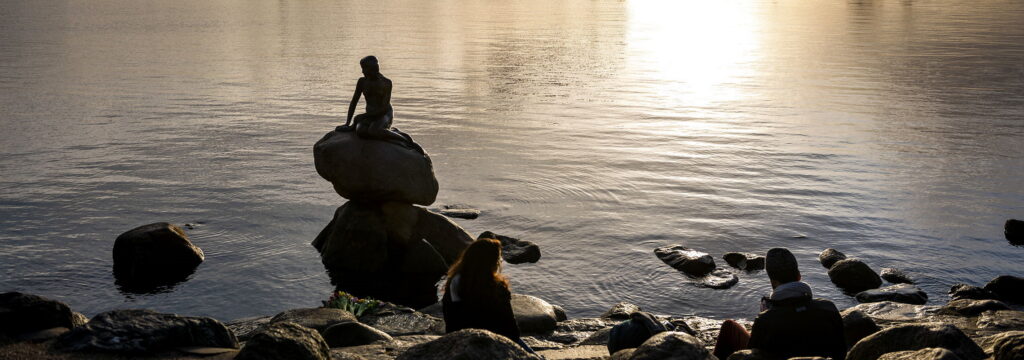
If both conditions are met, prior permission must be obtained from the author and remuneration paid. In these cases, the reproduction must clearly be the main motive. The term 'commercial' must be understood broadly and includes, for example, reproduction on postcards, posters, art calendars, in books, newspapers and magazines. Production and sale of postcards with a work of art as the main motif – e.g. 'The Little Mermaid' - requires permission.
The museums' reproductions
The museums do not have copyright to the works of art they have acquired - unless the copyright has been expressly transferred in connection with the acquisition of the works of art in question. Therefore, museums' reproductions of works of art on postcards, art calendars, textiles, the internet etc. generally require permission from the originator. The Copyright Act contains provisions that are particularly important for museums' publications.
These are briefly explained below:
Pure exhibition catalogues
Reproductions of works of art in exhibition catalogs are free of charge for as long as the exhibition lasts. By "exhibition catalogues" is understood here publications that contain the necessary lists of the contents of the art collection or exhibition. It must be a publication that is published and sold or given away in connection with the exhibition. When catalogs are sold after the exhibition (for example, the surplus, unsold copies) remuneration must be paid to the author. Subsequent reprinting may also not take place without prior permission. (In the standard agreement with the art museums, exhibition catalogs with a more defined, limited text section are called "pure catalogues"). It is assumed that this provision cannot be applied to internet catalogs on the basis of the current copyright law. Establishing an internet catalog therefore requires permission from the author.
Catalogs that have the character of generally informative art books or magazines
If catalogs are more in the nature of actual art books or magazines of a general informative nature, where article material and illustrations occupy a more dominant place than the actual catalog material, prior permission must always be obtained for the reproduction of works of art and remuneration paid. (In the standard agreement with the art museums, these catalogs are called 'exhibition catalogues').
Catalogs containing critical or scholarly articles
If catalogs contain critical or scientific articles, works of art may be reproduced in connection with the text, when this is done in accordance with good practice and to the extent determined by the purpose. It is a condition that no more works of art are reproduced than necessary to fulfill the purpose of the production. Reproduction on the cover of these catalogs is not covered by the provision.
Announcements about exhibitions in advertisements, mentions in newspapers, exhibition posters, etc
The organizer of an exhibition has access to advertising for an upcoming or ongoing exhibition, including in the form of a reproduction of one or more of the exhibited works of art. The provision does not allow access to reproduce works of art as an illustration for e.g. an article in an art journal, simply because the work is or will be the subject of exhibition or sale. It is assumed that the provision does not allow the exhibited works of art to be reproduced on the Internet without prior permission from the author. No remuneration must be paid for the reproduction of works of art on the part of the circulation of exhibition posters which are only to be used in connection with the museum's own information business, posters hung free of charge in shops etc. Remuneration must be paid for the reproduction of works of art on that part of the circulation , which are sold before, during or after an exhibition.
Postcards, art calendars, textiles, ceramics and other products with reproductions of works of art
Reproduction of artwork on these products follows the general rules of copyright law. They therefore always require prior consent and entail remuneration for the author.
Digital technology in museums
Digital technology enables the reproduction of works of art on machine-readable media such as CD, DVD, disk, memory card or on the museum's website on the Internet, intranet, etc. The general provisions of the Copyright Act also apply in this area.
Books and teaching material
Reproduction of works of art in books is basically covered by the author's exclusive right to make copies of his work. This means that the author must give advance permission for reproduction before the book goes to press.
In order to facilitate the publication of general information works with many images by many different authors, such as Den Store Danske Encyklopædi, an agreement licensing scheme has been introduced, according to which VISDA, on behalf of the rights holders, gives a commitment to a limited exploitation in return for payment of remuneration. However, the individual author can ban the reproduction of his works.
For educational material, it is permitted – without prior permission from the copyright holder – to reproduce art in educational anthologies when five years have passed from the year in which the works were published. The visual artist is entitled to remuneration, which is paid to VISDA without demand, if the artist in question has transferred the management of his rights thereto.
Photocopying
Photocopying for use in education or in a business enterprise is also copy-making within the meaning of the Copyright Act. In practice, it is impossible to obtain prior permission for the mass copying that takes place in schools and other educational institutions as well as in commercial enterprises. These have therefore entered into agreements with the authors' organizations within the framework of VISDA. The agreements give them advance permission to photocopy within the specified limits for use in teaching or for internal use in the business enterprise against payment of a total annual fee to VISDA.
The right to follow
The Copyright Act basically gives the author the exclusive right to make the work available to the public. In the case of works of art, the rule only applies as long as the author has not published the work or transferred it to others. Once this has happened – with the author's consent – the copy may be sold on. And the author has no influence on who the work is resold to or at what price.
However, under copyright law, visual artists are entitled to a fee when their original works are resold. There must, among other things, royalties are paid for paintings, collages, drawings, engravings, prints, lithographs, sculptures, tapestries, ceramic art, glass art and photographic works. The provision includes copies of works of art which have been produced in one copy or in a limited number by the author himself or with his permission.
Royalties must be paid for all resales where professionals on the art market participate as sellers, buyers or intermediaries, including auction houses, art galleries and art dealers.
The obligation to pay remuneration rests with the seller or intermediary. Remuneration must only be paid if the selling price exceeds 300 Euro (excl. VAT). The total remuneration cannot exceed 12.500 Euro (excl. VAT) per specimen.
The right to remuneration lasts until the copyright expires. The right is personal and cannot be transferred. After the author's death, however, the right is inherited by the author's spouse and life heirs. If the author leaves no spouse or life heirs, the right to remuneration accrues to an organization approved by the Minister of Culture – today it is VISDA. VISDA oversees the collection and makes the distribution to those entitled.
The display right
The Copyright Act basically gives the author the exclusive right to make the work available to the public by showing it publicly.
As long as the artwork is still in the artist's possession, he decides whether it should be shown to others, and he can of course stipulate a fee for the right to exhibit it. The situation is different when a work of art is published or handed over to others with the author's consent. Then the author can no longer object to the work of art being publicly exhibited or otherwise shown to the public. (However, the provision does not apply to the display of copies of works of art on television or in films).
The author is not entitled to any remuneration in connection with the exhibition/screening. A right to remuneration in connection with the exhibition of works of art is continuously discussed in connection with revisions of the Copyright Act/Visual Art Act.
Works of art on television
Display of visual art on television requires permission from the creator. The remuneration is typically set according to the price list from VISDA. As far as the sale of art videos etc. for TV is concerned, please refer to BKF's indicative price list.
Use of music
If you wish to use music in connection with a work, permission can be sought from the Nordic Copyright Bureau (NCB): www.ncb.dk.
Copyright infringements
Violation of the copyright law can result in sanctions in the form of punishment - fine or
imprisonment of up to one year - as well as compensation and compensation to the injured party. In the event of infringements, rights holders can at least demand reasonable remuneration for the illegal use as well as compensation
and/or fine.
The author can also issue a bailiff's ban against a use of the work that infringes the rights. It is important that infringements of copyright are reported in writing immediately after you have learned that your copyright has been infringed.
The frequent violations; lack of credit, failure to obtain advance commitments, etc. settled as a starting point according to the price list for VISDA. Other copyright infringements are typically determined on the basis of court practice.
BKF assists the members with advice and guidance as well as possible support amounts in the event of infringements of copyright.
Artikler's report
- News, Misc
Member has been required to pay full tax on a production grant from the Statens Kunstfond.
- News, Misc